
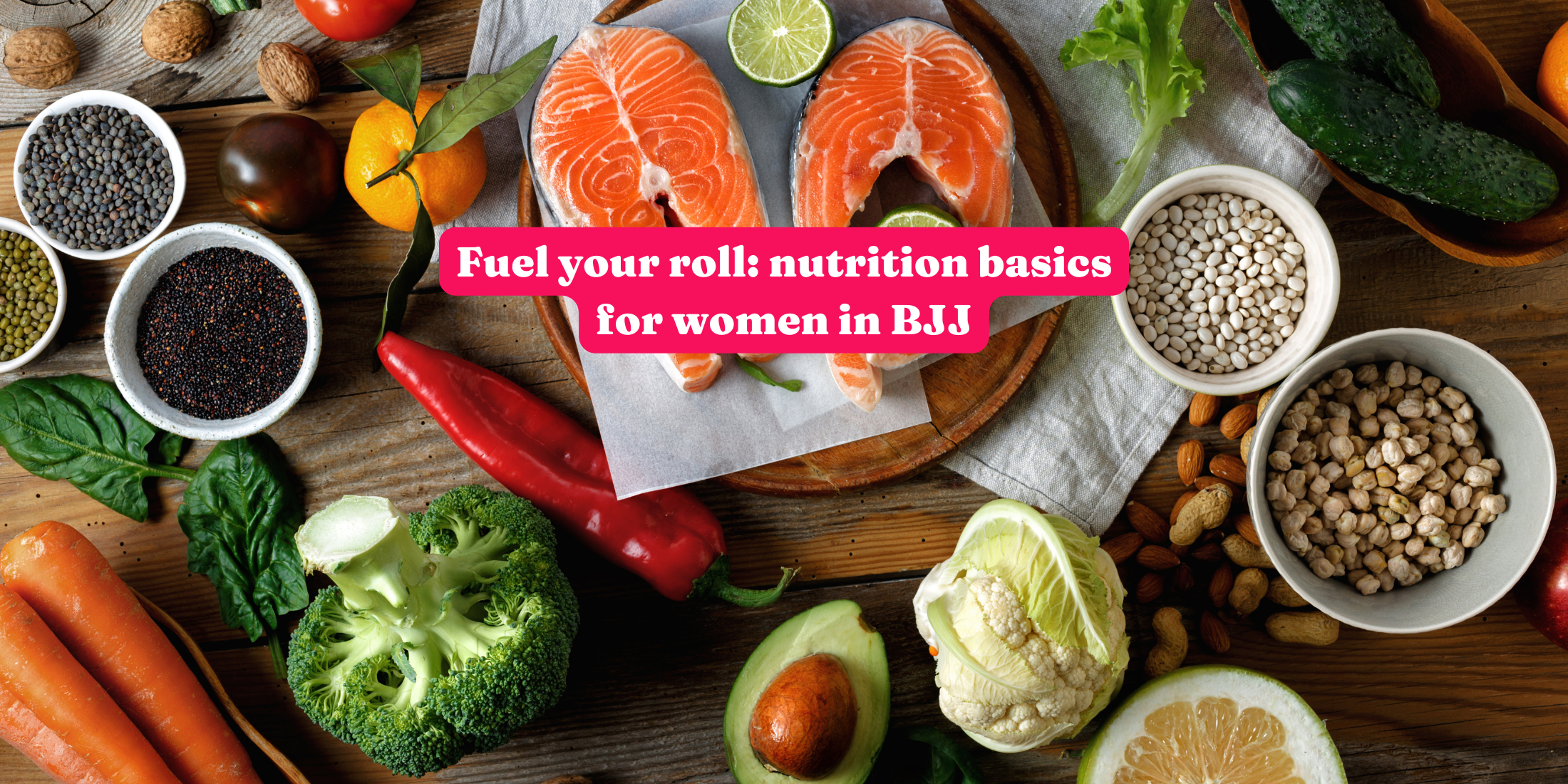
One of the questions that comes up most often in our community is: what should I be eating for BJJ? It makes sense. Jiu-jitsu is demanding in ways that catch a lot of new practitioners off guard. You finish a session exhausted in a way that running or gym training never quite produced. You are hungrier than usual. Your body is adapting to something new.
This guide is our attempt to give you a solid, evidence-based foundation to work from. It draws on peer-reviewed sports nutrition research and the guidelines of leading organisations, including the International Society of Sports Nutrition (ISSN) and the Australian Institute of Sport (AIS). Most importantly, it is written specifically for women, because most sports nutrition research has historically been conducted on men, and our physiology works differently in ways that matter.
This is a general educational resource, not personalised dietary advice. If you have specific health concerns, please consult a registered dietitian or sports medicine professional.
A word on hunger and the scale
If you have recently started BJJ and find yourself significantly hungrier than before, that is normal. Jiu-jitsu places demands on your muscles, joints, and nervous system that most forms of exercise do not. Your body is repairing, adapting, and building.
Something worth knowing early: if you train consistently and eat well, you may find the number on the scale goes up before it does anything else. This is not cause for alarm. Dense muscle tissue weighs more than fat. What you are likely building is a stronger, more capable body. Over time, if you are fuelling consistently and training regularly, excess body fat tends to reduce gradually without any drastic intervention.
The scale is one data point. How you feel on the mat, how quickly you recover, and how your clothes fit are better ones.
Macronutrients: your three energy pillars
Protein = the foundation
Protein is the most critical macronutrient for grappling athletes. BJJ places enormous demand on muscle tissue through gripping, bridging, and explosive scrambles. Protein repairs that damage and drives adaptation, and most women do not eat nearly enough of it.
As a rough guide:
Recreational training (1 to 3 sessions per week): 1.4 to 1.7 g per kg of bodyweight daily
Regular training (4 to 5 sessions per week): 1.7 to 2.0 g per kg daily
High volume or competition prep: 2.0 to 2.4 g per kg daily
For a 63 kg woman training regularly, that is roughly 107 to 126 g of protein a day. Spread it across meals rather than loading it into one sitting. Research shows that around 25 to 30 g per meal maximises muscle protein synthesis. Do not skip breakfast -- it is your first recovery window of the day.
Sources: Morton et al. (2018) BJSM; Stokes et al. (2018) Nutrients; ISSN Position Stand on Protein
Carbohydrates = your training fuel
Despite the popularity of low-carb diets, carbohydrates are the primary fuel for high-intensity intermittent efforts, which is exactly what BJJ demands. Glycogen (stored carbohydrate) powers your explosive sweeps, takedowns, and late-round scrambles. Cutting carbs before training is one of the fastest ways to feel flat and slow on the mat.
Match your carbohydrate intake to your training load:
Light training days: 3 to 4 g per kg of bodyweight
Moderate training days (1 to 1.5 hours): 4 to 5 g per kg
Heavy days or competition: 5 to 7 g per kg
Prioritise whole foods such as oats, rice, sweet potato, fruit, legumes, and whole-grain bread. Reserve fast-digesting carbs like white rice and bananas for pre- and intra-training windows when quick availability matters most.
Source: Burke et al. (2011) J Sports Sci; Thomas et al. (2016) ACSM/AND/DC Position Statement
Fats, hormones, joints and absorption
Dietary fat supports oestrogen production, joint lubrication, and the absorption of fat-soluble vitamins A, D, E, and K. Dropping fat too low disrupts the menstrual cycle and suppresses performance-critical hormones, which is a common consequence of under-eating that often goes unrecognised.
Aim for 0.8 to 1.2 g per kg per day, with a minimum of 20% of your total daily calories coming from fat. Prioritise avocado, extra-virgin olive oil, oily fish, nuts, seeds, and eggs.
Source: De Souza et al. (2014) BJSM -- Relative Energy Deficiency in Sport (RED-S)
Hydration is the most underrated performance variable
Even 2% dehydration measurably impairs reaction time, decision-making, and muscular endurance. South African training conditions, particularly during summer and in gyms without air conditioning, make this more acute than many athletes realise.
Aim for 35 to 45 ml per kg of bodyweight per day as a baseline. Your urine colour is the simplest check: pale yellow means well hydrated; dark yellow means drink more.
Around training:
2 hours before: 400 to 600 ml of water or an electrolyte drink
During sessions over 60 minutes: 150 to 250 ml every 15 to 20 minutes, ideally with a sodium source
After training:
Rehydrate immediately, aiming for around 1.5 times the fluid you lost
Sweat contains sodium, potassium, magnesium, and chloride, not just water. For sessions over 60 to 90 minutes, add a pinch of salt to your water, use a quality electrolyte tablet, or try coconut water as a natural alternative.
Caffeine at 3 to 6 mg per kg of bodyweight (roughly 1 to 2 cups of coffee) improves endurance, alertness, and pain tolerance and does not cause meaningful dehydration. Consume 30 to 60 minutes before training, and avoid it within 6 hours of sleep.
Source: Maughan et al. (2018) BJSM IOC Consensus Statement on Dietary Supplements
Nutrient timing: when you eat matters
Before training
Two to three hours before a session, focus on easily digestible carbohydrates with moderate protein. Keep fat and fibre relatively low, as both slow digestion and can cause discomfort on the mat. If you need a small top-up 30 to 60 minutes before training, keep it simple: a banana with a handful of nuts, a rice cake with peanut butter and honey, or a small yoghurt with fruit.
After training
The two hours after training are when your muscles are most primed to absorb and use nutrients. Aim for 20 to 40 g of protein and 0.8 to 1.2 g of carbohydrates per kg of bodyweight within that window. Start rehydrating immediately.
One underrated option is low-fat chocolate milk. It delivers an ideal carbohydrate-to-protein ratio, fluids, and electrolytes in one drink, and has been consistently shown in research to be one of the most effective post-exercise recovery options. It is also affordable and accessible.
Source: Kerksick et al. (2017) ISSN Position Stand: Nutrient Timing
Hormones and your cycle, train with your biology
This is the section most sports nutrition guides skip. The menstrual cycle directly influences metabolism, energy availability, muscle protein synthesis, and injury risk. Understanding these shifts is not complicated, it just requires knowing the basics.
Follicular phase (Days 1 to 14)
From menstruation through ovulation, oestrogen is rising. This phase generally feels better for high-intensity training. The body prefers to burn carbohydrates as fuel, so slightly higher carbohydrate intake supports performance well. Iron-rich foods are particularly important post-menstruation to replenish losses, red meat, legumes, and dark leafy greens, always paired with vitamin C to improve absorption.
Luteal phase (Days 15 to 28)
After ovulation, progesterone rises, and core body temperature increases. The body shifts toward burning more fat as fuel, and total daily energy expenditure increases by 100 to 300 kcal. Many women experience reduced endurance, increased perceived effort, and stronger cravings during this phase. These responses are physiologically real, not a lack of discipline.
Practical adjustments that help:
Increase total calorie intake slightly, particularly protein and healthy fats
Higher core temperature means more fluid loss, so increase hydration
Magnesium-rich foods such as dark chocolate, nuts, seeds, and leafy greens may reduce cramping and mood symptoms.
Reducing high-sodium processed foods can help minimise bloating
Sources: McNulty et al. (2020) Sports Medicine; Elliott-Sale et al. (2021) Sports Medicine
Supplements and what the evidence actually supports
A well-structured whole-food diet addresses most nutritional needs. Supplements fill gaps -- they do not replace foundations. These are the ones with the strongest evidence for female athletes.
Creatine monohydrate is the most researched performance supplement in existence. It improves strength, power output, and recovery. Women have lower natural creatine stores than men, which makes supplementation particularly beneficial. A dose of 3 to 5 g per day is sufficient, with no loading phase required. You may notice a small initial increase on the scale. This is water being drawn into muscle cells, not fat gain.
Caffeine at 3 to 6 mg per kg of bodyweight improves endurance, strength, focus, and pain tolerance when taken 30 to 60 minutes before training. Tolerance builds over time, so consider cycling off periodically.
Vitamin D3 paired with K2 supports bone health, immunity, and muscle function. Despite South Africa's sunshine, indoor athletes and those with darker skin tones may not synthesise enough. A dose of 1,000 to 2,000 IU per day with food is a reasonable starting point.
Iron is important for female athletes, given the combination of menstrual losses and training demand. Symptoms of deficiency include fatigue, reduced performance, and persistent brain fog. Get blood levels checked before supplementing. A food-first approach using red meat, legumes, and spinach paired with vitamin C is always preferable.
Omega-3 (fish oil) at 2 to 3 g of EPA+DHA per day reduces exercise-induced inflammation and supports joint health, which matters in a sport that puts considerable load on fingers, wrists, elbows, and knees.
Magnesium glycinate at 200 to 400 mg before bed may reduce cramping, PMS symptoms, and improve sleep quality, all of which directly affect how well you recover and perform.
Sources: Lanhers et al. (2017) Creatine meta-analysis; ISSN Position Stand on Caffeine; Mountjoy et al. (2018)
Six principles to come back to
Eat enough. Underfuelling is the most common mistake female athletes make, and one of the hardest to spot in yourself.
Prioritise protein. Aim for 1.6 to 2.2 g per kg daily, spread across 3 to 5 meals.
Do not fear carbohydrates. Match intake to training load. More on hard days, moderate on rest days.
Stay hydrated. Drink consistently through the day. Add electrolytes for longer or hotter sessions.
Understand your cycle. Use your follicular phase for your hardest sessions. Eat a little more in the luteal phase. Track it.
Consistency beats perfection. You do not need to eat perfectly every day. A consistently good diet will always outperform sporadic clean eating.
This article is a general educational resource and is not a substitute for personalised medical or dietary advice. If you have specific health concerns, please consult a registered dietitian or sports medicine professional.
Looking for a female-friendly gym near you?
Browse the BJJ gym directory →